%20(Transparent%20Background%20(2).png)


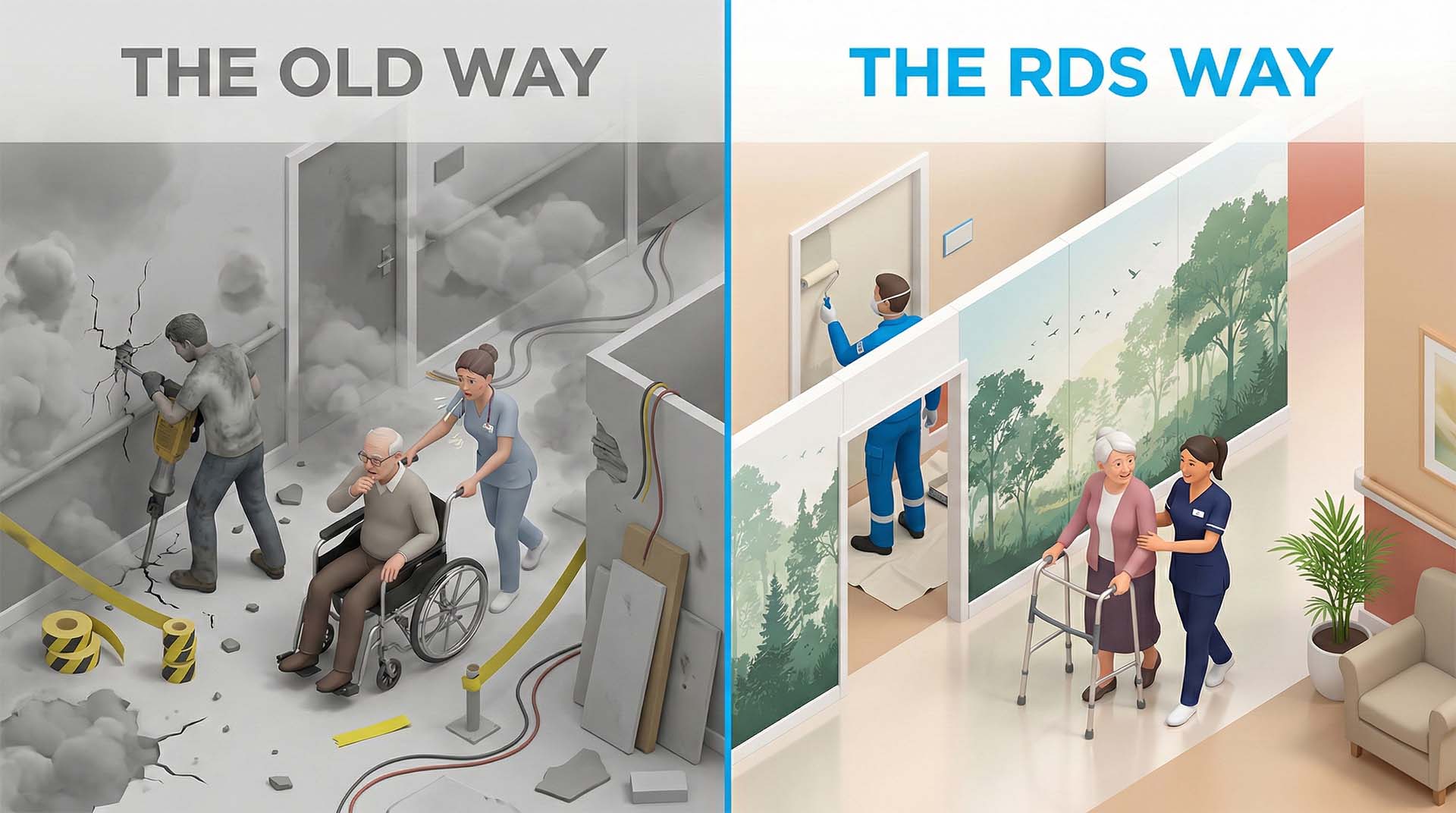

For care home operators, the decision to renovate is often a balancing act. On one side, you have the urgent need to modernize facilities, improve CQC ratings, and attract private-pay residents. On the other, you have the terrifying prospect of disruption: noise, dust, and the potential distress caused to vulnerable residents.
For care home operators, the decision to renovate is often a balancing act. On one side, you have the urgent need to modernize facilities, improve CQC ratings, and attract private-pay residents. On the other, you have the terrifying prospect of disruption: noise, dust, and the potential distress caused to vulnerable residents.
The question isn't if you should renovate, but how.
At RDS CareBuild, we specialize in "live environment" construction. We understand that a care home is not a building site; it is a home. Here is our expert guide to managing care home renovation services safely, efficiently, and without compromising the quality of care.
The Golden Rule: Phasing is Everything
The difference between a nightmare project and a seamless upgrade lies in the phasing strategy. You cannot simply "start work." You must surgically isolate areas of the home to ensure the daily routine of care continues uninterrupted.
How We Structure a Phased Renovation
Instead of closing a whole floor (which kills your occupancy revenue), we typically break the project into "micro-phases":
- The "Buffer" Zone: We identify a small cluster of 2-3 empty rooms to act as a swing space.
- The Rolling Refurb: We refurbish one cluster of rooms at a time. Once Cluster A is finished and snagged, residents from Cluster B move into the brand-new rooms, and work begins on their old rooms.
- The "invisible" Workflow: Our teams use separate access points, external scaffolding staircases, and acoustic barriers to ensure that construction traffic never crosses paths with residents.
Safety First: Protocols for "Live" Environments
When we act as your care home refurbishment partners, we operate under a stricter set of Health & Safety protocols than a standard construction site.
1. Infection Control & Dust Management
In a post-COVID world, air quality is critical. We use negative air pressure systems in our working zones to ensure dust and potential pathogens do not migrate into resident areas. All site operatives wear overshoes and clean PPE when transiting near "clean" zones.
2. Dementia-Friendly Construction
Noise and change can be deeply unsettling for residents with dementia. We mitigate this by:
- "Quiet Hours": Scheduling drilling and heavy impact work strictly between 10:00 AM and 4:00 PM, avoiding breakfast and evening wind-down times.
- Visual Screening: We don't just use hazard tape. We install full-height hoardings that look like finished walls (often decorated with calming imagery) so residents don't see a "building site"—they just see a wall.
- Tool Tethering: Ensuring no tools are ever left unattended, even for a second.
CQC Compliance: Don't Just Renovate, Upgrade
A renovation is the perfect opportunity to fix legacy issues that might be dragging down your CQC rating. Your care home renovation budget should work double-time to improve safety standards.
Key Upgrades to Include:
- Sluice Rooms: Are your sluice rooms touch-free? Upgrading to hands-free access control and macerators is a quick win for infection control ratings.
- Lighting: Replacing old fluorescent tubes with circadian-rhythm LED lighting helps regulate residents' sleep patterns and can reduce falls by improving visibility.
- Flooring: Swapping carpet for impervious, anti-slip vinyl (that looks like wood) reduces smell retention and improves hygiene scores immediately.
Managing Stakeholders: Communication is Key
The success of a project often depends on how the residents' families feel about it. If they see a chaotic building site, they panic. If they see a managed improvement, they are excited.
We recommend a "Renovation Communication Plan":
- The "Town Hall" Meeting: Before we start, we (RDS CareBuild) and your management team present the plans to residents and families, showing them samples of the new curtains, chairs, and colors.
- The "Look Ahead" Board: A simple whiteboard in reception telling visitors: "This week we are painting the East Wing. Next week we start the new Garden Room."
- Staff Engagement: Your staff are our eyes and ears. We hold weekly briefings with your Home Manager to ensure our schedule aligns with your care needs (e.g., pausing work for a resident's birthday party or a sensitive palliative care situation).
Case Study Snapshot: Refurbishing in Cheshire
(Note: This is a placeholder for a real case study if you have one, or a hypothetical example based on your services)
When a 40-bed care home in Cheshire needed a full ground-floor upgrade, they couldn't afford to close. RDS CareBuild delivered a 12-week program of care home renovation services while the home remained at 95% occupancy. By using an external gantry for materials handling, we removed 100% of construction waste without it ever passing through the main reception.
Why Choose RDS CareBuild?
We are not general builders who "also do" care homes. We are specialists in care home construction and renovation. We know that a delay on a bathroom fit-out isn't just an inconvenience—it's a resident who can't bathe with dignity.
Ready to upgrade your facility without the stress? Contact us today to discuss your refurbishment project and learn how we can modernize your home while keeping your doors open.